


Toothpastes
Over 95% of the toothpaste sold in the U.S. now contains fluoride, with many grocery stores carrying few if any non-fluoridated brands. The use of fluoride toothpaste, particularly during early childhood, presents health risks. This is why the FDA requires a poison warning on every tube of fluoride toothpaste now sold in the US.
Risks from ingesting fluoride toothpaste include permanent tooth discoloration (dental fluorosis), stomach ailments, acute toxicity, skin rashes (perioral dermatitis), and impairment in glucose metabolism. All of these risks have been unnecessarily increased by the marketing practices of toothpaste manufacturers, who use cartoon packaging and candy-flavors to target *adult-strength* fluoride toothpaste to young *children.* The dental community’s failure to educate the public about the dangers of swallowing too much fluoride toothpaste has further exacerbated the problem.
A Major Source of Children’s Daily Fluoride Intake
Fluoride toothpastes sold in the U.S. generally contain between 1,100 and 1,450 parts per million (ppm) fluoride (the equivalent of over 1 mg of fluoride for each gram of paste). Although the fine print on the back of the toothpaste tube instructs users not to swallow and to use only a “pea-sized” amount, advertisements continue to depict heaping swirls of paste on the brush, (Basch 2013), and manufacturers continue to market fluoride toothpastes in bubble-gum, fruit, and candy-like flavors (Basch 2014). Using child-appealing flavors is particularly dangerous because young children have poorly developed swallowing reflexes, and invariably swallow large amounts of the paste they add to the brush.
Not surprisingly, numerous studies have found that many children ingest a significant amount of fluoride each day from toothpaste alone. According to the Journal of Public Health Dentistry: “Virtually all authors have noted that some children could ingest more fluoride from [toothpaste] alone than is recommended as a total daily fluoride ingestion.” (Levy 1999).
A Major Risk Factor for Dental Fluorosis
One side effect from swallowing too much fluoride is dental fluorosis. Dental fluorosis is a defect in tooth enamel caused by excessive fluoride intake during the tooth-forming years (age 0 to 8). In its mild forms, dental fluorosis presents as cloudy white splotches and streaks on the teeth, while in its moderate and severe forms, fluorosis can cause extensive brown and black staining along with pitting and crumbling of the enamel. Children who ingest a lot of toothpaste (whether accidentally or purposefully), can develop the disfiguring brown and black stains of advanced fluorosis, particularly if they also drink fluoridated water. Fluorosis on the front teeth, even in its “mild” forms, but especially in its severe forms, can cause self-esteem problems for a child, particularly when they reach adolescence.
Acute Poisoning
In 1997, the FDA ordered toothpaste manufacturers to add a poison warning on all fluoride toothpastes sold in the U.S. The warning reads:
“Keep out of reach of children under 6 years of age. If you accidentally swallow more than used for brushing, seek professional help or contact a poison control center immediately.”
The FDA requires this warning because children who swallow too much fluoride toothpaste can suffer acute poisoning, even death. In fact, a single tube of bubble-gum flavored Colgate-for-Kids toothpaste contains enough fluoride (143 mg) to kill a child weighing less than 30 kg. (Whitford 1987a).
While fatalities from fluoride ingestion are rare (the last reported death occurred in 2002), bouts of acute fluoride poisoning are not. Acute fluoride poisoning, which occurs at doses as low as 0.1 to 0.3 mg per kg of bodyweight, generally presents in the form of gastric pain, nausea, vomiting, headache, dizziness, and flu-like symptoms. (Akiniwa 1997; Gessner 1994). A child weighing 10 kg would only need to ingest 1 to 3 grams of paste (less than 3% of a tube of Colgate-for-Kids) to experience one or more of these symptoms.
Although it is believed that many poisoning incidents from fluoride toothpaste go undiagnosed and unreported (Shulman 1997), the number of calls to Poison Control Centers in the U.S. for fluoride poisonings from toothpaste has skyrocketed since the FDA issued its poison warning. Indeed, in the early 1990s (prior to the FDA’s warning), there were about 1,000 poisoning reports each year from fluoride toothpaste. (Shulman 1997). Today, there are over 23,000 reports a year, resulting in hundreds of emergency room treatments.
| Reports to Poison Control Centers in U.S. Due to Excessive Ingestion of Fluoride Toothpastes Data from: Brownstein (2009, 2010) & Watson (2003) |
||||||||
| # Treated in Emergency Room |
Medical Outcome* | |||||||
| Year | Product | # Reports | None | Minor | Moderate | Major | Death | |
| 2009 | F Toothpaste | 24,547 | 378 | 4,781 | 1,146 | 42 | 2 | 0 |
| 2008 | F Toothpaste | 23,468 | 383 | 4,395 | 1,119 | 43 | 1 | 0 |
| 2002 | F Toothpaste | 24,087 | 411 | 4,852 | 1,218 | 40 | 1 | 1 |
| * Minor effect: Minimally bothersome signs or symptoms that generally resolved without residual disability or disfigurement (e.g. self-limiting gastrointestinal symptoms). Moderate effect: More pronounced or prolonged signs or symptoms, or more of a systemic nature than minor systems. While the symptoms are not life-threatening (e.g., disorientation or high fever that responds readily to treatment), some form of treatment is indicated. Major effect: Signs and symptoms that are life-threatening or result in significant residual disability or disfigurement. (Shulman 1997) | ||||||||
Skin Rashes
Among some individuals, the use of fluoride toothpaste may cause or aggravate perioral dermatitis (a rosacea-like skin rash around the mouth). (McCaffery 2003; Mellette 1983, 1976). The condition usually appears in women between the ages of 20 and 50. Where fluoride toothpaste is the cause of the condition, significant improvement in symptoms will be experienced within a few weeks of using a non-fluoridated toothpaste. In addition to dermatitis, fluoride toothpaste may also cause stomatitis (i.e., mouth ulcers, “canker sores”). (Brun 2004; Douglas 1957).
Impaired Glucose Metabolism
Perhaps the most important, yet most overlooked, risk from excessive ingestion of fluoride toothpaste, is the impact it can have on blood glucose and insulin levels. In the 1980s, researchers at the University of Indiana reported that rats receiving acute, but relatively small, doses (0.5 mg/kg) of fluoride, had significantly higher glucose levels in their blood, and decreased levels of insulin. (Shahed 1986; Whitford 1987b). Since that time, numerous studies have repeated this finding (in both animals and humans) at doses which many children routinely ingest from fluoride toothpaste. It is now estimated, for example, that blood fluoride levels of just 95 ppb produce an increase in glucose levels and a decrease in insulin. (Menoyo 2005). Strikingly, this level is routinely exceeded by about 5 to 10% of children using fluoride toothpaste (particularly those living in fluoridated communities).
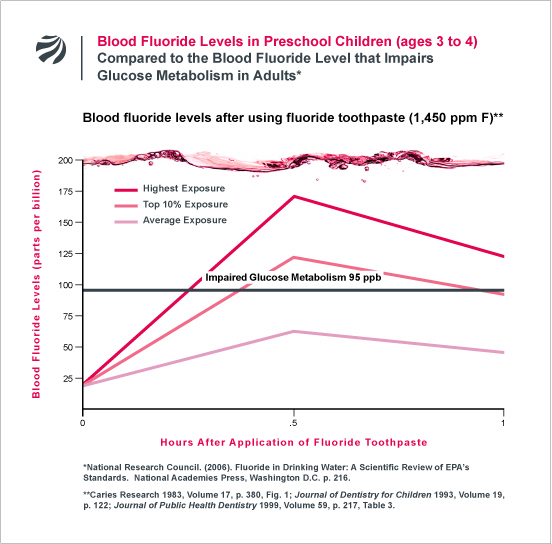
This finding raises the obvious question of whether the widespread use and ingestion of fluoride toothpaste is contributing to, or exacerbating, the rising prevalence of diabetes in children. Diabetes is a condition caused by persistently high glucose levels. A chemical that can simultaneously increase glucose levels and decrease insulin (insulin is a hormone that helps clear glucose from the blood) should be handled very carefully, particularly among those who already have diabetes. Indeed, several researchers have already begun suggesting that diabetic children should use toothpastes with low-fluoride content. As noted by the authors in a recent study from the Journal of Fluoride Chemistry:
“[K]nowing that chronic [fluoride] intake is capable of decreasing insulin signal and causing insulin resistance, the use of dentifrices with lower F content is recommended, especially for diabetic children, for whom excessive F consumption may lead to health implications.” (Chiba 2012).
References:
- Akiniwa, K. (1997). Re-examination of acute toxicity of fluoride. Fluoride 30: 89-104.
- Basch CH, Rajan S. (2014). Marketing strategies and warning labels on fluoride toothpaste. Journal of Dental Hygiene 88(5):316-9.
- Basch CH, et al. (2013). Advertising of toothpaste in Parenting Magazines. Journal of Community Health 38(5):911-4.
- Bronstein AC, et al. (2010). 2009 Annual Report of the American Association of Poison Control Centers’ National Poison Data System (NPDS): 27th Annual Report. Clinical Toxicology 48:979-1178.
- Bronstein AC, et al. (2009). 2008 Annual Report of the American Association of Poison Control Centers’ National Poison Data System (NPDS): 26th Annual Report. Clinical Toxicology 47:911-1084.
- Brun R. (2004). Recurrent Benign Aphthous Stomatitis and Fluoride Allergy. Dermatology 208: 181.
- Chiba FY, et al. (2012). NaF treatment increases TNF-a and resistin concentrations and reduces insulin signal in rats. Journal of Fluorine Chemistry 136:3-7.
- Gessner BD, et al. (1994). Acute fluoride poisoning from a public water system. New England Journal of Medicine 330:95-9.
- Levy SM, Guha-Chowdhury N. (1999). Total fluoride intake and implications for dietary fluoride supplementation. Journal of Public Health Dentistry 59: 211-23.
- McCaffery K. (2003). Fluoride and dermatitis. Journal of the American Dental Association 134: 1166.
- Mellette JR, et al. (1983). Perioral dermatitis. Journal of the Association of Military Dermatologists 9: 3-8.
- Mellette JR, et al. (1976). Fluoride tooth paste: A cause of perioral dermatitis. Archives of Dermatology 112: 730-731.
- Menoyo I, Rigalli A, Puche RC. 2005. Effect of fluoride on the secretion of insulin in the rat. Drug Res 55(5):455-60.
- Shahed AR, et al. (1986). Effect of F on rat serum insulin levels in vivo. Journal of Dental Research 65:756.
- Shulman JD, Wells LM. (1997). Acute fluoride toxicity from ingesting home-use dental products in children, birth to 6 years of age. Journal of Public Health Dentistry 57: 150-8.
- Watson WA, et al. (2003). 2002 Annual Report of the American Association of Poison Control Centers Toxic Exposure Surveillance System. American Journal of Emergency Medicine 21:353-421.
- Whitford GM. (1987a). Fluoride in dental products: safety considerations. Journal of Dental Research 66: 1056-60.
- Whitford GM, et al. (1987b). Topical fluorides: effects on physiologic and biochemical processes. Journal of Dental Research 66(5):1072-8.
 Print
Print  PDF
PDF
-
-

Don't Swallow Your Toothpaste
Related Videos:
-
-
-
Hazards lurk in toothpaste tube
Doctors worked for weeks to find the source of 5-year-old Crystal Mustonen's nightly bouts of nausea and vomiting.
-
FDA Adds Poison Warning to Fluoride Toothpaste
Last month, as 8-year-old Molly Statt stood in the bathroom brushing her teeth, something on the back of the large-size tube of Crest caught her attention. She stopped brushing. Looking up at her father standing beside her, she motioned to the toothpaste and asked, "Is this poison?" "Of course not," Paul Statt reassured his daughter. "Then why does it say 'poison' on it?" she asked.
-
Toothpaste label revs up some anxiety
Words like "poison" and "do not swallow" do not belong on the label of anything you put in your mouth even once a day. But there they were, on my Arm & Hammer, on a tube of Colgate in my travel case, on my husband's "natural" Tom's of Maine. When I visited my local drugstore, I found similar words -- including the P word -- on every brand I checked.
Related Articles:
-
-
-
Fluoride & Gastrointestinal System: The Importance of Fluoride Concentration in Stomach
The following is an excerpt from the National Research Council's (2006) review of fluoride toxicity: "It is important to realize that GI effects depend more on the net concentration of the aqueous solution of fluoride in the stomach than on the total fluoride dose in the fluid or solid ingested. The
-
Fluoride-Induced Damage to Gastric Mucosa in Human Clinical Trials
When fluoride has been used (at doses of 18-34 mg/day) as an experimental treatment for osteoporosis, gastric pain is one of the two main side effects consistently encountered. To better understand how fluoride causes this effect, researchers have sought to determine how fluoride affects the tissue that lines the gastrointestinal tract. In a
-
Fluoride-Induced Gastric Symptoms in Human Clinical Trials
In studies where fluoride has been used (at doses of 18-34 mg/day) as an experimental drug for the treatment of osteoporosis, gastrointestinal disturbances are one of the two main side effects consistently encountered. The following are some of the accounts from the published literature: "The use of fluoride in the prophylaxis or
Related Studies:
-
-
-
Fluoride Intake from Toothpaste vs. Recommended Daily Intake from All Sources
For many children, fluoride toothpaste is the largest source of fluoride intake. One strip of fluoridated toothpaste on a child-sized toothbrush contains between 0.75 and 1.5 mg of fluoride, which is more fluoride than is found in many prescription fluoride supplements (0.25 to 1.0 mg per tablet). Since young children are
-
The Wichita Eagle's Fact-Challenged Reporting on Fluoride
During the run-up to a referendum on fluoridation in Wichita, Kansas, the city's local paper (the Wichita Eagle) became an ardent advocate of fluoridated water. In it's zeal for fluoridation, the Eagle turned its backs on one of the basic tenets of good journalism by allowing the paper's editorial view
Related Miscellaneous Content:
-