

Tea
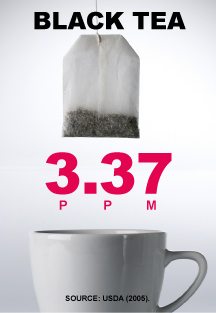 Tea plants readily absorb fluoride from soil. As a result, tea drinks invariably contain high levels of fluoride. In the United States, brewed black tea averages about 3 to 4 parts ppm fluoride, while commercial iced tea drinks contain between 1 and 4 ppm. (Izuora 2011; Whyte 2006; USDA 2005). Excessive consumption of tea beverages thus creates a risk for fluoride toxicity.
A Risk of Fluoride Toxicity
In recent years, there have been a number of reports documenting skeletal fluorosis in the United States among heavy tea drinkers. Dr. Michael Whyte, who has authored several of these studies, cautions that “many” tea drinkers are currently receiving fluoride doses that put them at risk for skeletal fluorosis. (Whyte 2008). In Whyte’s studies, the tea drinkers who developed skeletal fluorosis had been misdiagnosed for years as suffering from arthritis and/or fibromylagia. In Whyte’s most recent study, a Georgia woman had crippling skeletal fluorosis for up to 18 years before being correctly diagnosed. (Whyte 2011). As some authors have noted, “it is certain that some heavy-tea drinkers suffering from fluorosis from tea-drinking might not be diagnosed.” (Yi & Cao 2008).
Benefits of Tea
While the fluoride levels in tea are high, it is important to also consider that tea leaves contain a natural antidote to fluoride toxicity: namely, anti-oxidants. In particular, tea contains high levels of “polyphenols” which are effective at countering oxidative stress in the body. Since oxidative stress is believed to be a key mechanism by which fluoride damages cells in the body, the high levels of anti-oxidants in some teas can help to mitigate the impact of the high fluoride levels.
Higher Quality Teas Have Lower Levels of Fluoride
Unfortunately, the tea products that contain the highest levels of fluoride also happen to be the tea products that contain the least anti-oxidants. This is because the level of anti-oxidant level in tea is lowest in old leaves (when fluoride content is at its highest), and highest in young leaves (when fluoride content is at its lowest). The fluoride content of tea has thus been proposed as an indicator of its quality: the more fluoride, the lower the anti-oxidants, and thus the lower the quality.
Minimizing Your Risk
To minimize your risk of fluoride toxicity from tea, therefore, it is best to drink tea drinks such as “white tea” that are made from young leaves. Since white tea provides more anti-oxidant protection and less fluoride than older teas it will reduce the risk (albeit not eliminate it) of developing fluoride toxicity. While this does not necessarily foreclose the risk of fluoride toxicity, it will reduce it vis-a-vis the fluoride risk from older, lower quality teas.
Another way of reducing fluoride intake from tea is to switch to yerba matte, a South American tea drink that has been found to contain minimal levels of fluoride.
Documentation:
 Print
Print  PDF
PDF
-
-
Bottled Tea Beverages May Contain Fewer Polyphenols Than Brewed Tea
The first measurements of healthful antioxidant levels in commercial bottled tea beverages has concluded that health-conscious consumers may not be getting what they pay for: healthful doses of those antioxidants, or "poylphenols," that may ward off a range of diseases. Scientists reported at the 240th National Meeting of the American Chemical
-
Fluoride, Arthritis, and the Specter of Misdiagnosed Skeletal Fluorosis in the US
It has been known since the 1930s that ingesting too much fluoride can cause stiff and painful joints. According to scientists who have studied this condition (commonly referred to as skeletal fluorosis), the joint damage caused by fluoride may mimic other, more common, forms of “arthritis,” making it easy to
-
Harmful Fluoride Levels Found in Instant Iced Tea
Instant iced tea mixes may contain potentially harmful levels of fluoride, according to a new study. The results indicate constantly quenching your thirst with instant iced teas may increase your risk of a rare, but potentially dangerous bone disorder caused by getting too much fluoride in your system.
Related Articles:
-
-
-
The Lancet: Fluoride Studies in a Patient with Arthritis
It is possible that fluoride intake from tea may be sufficient to cause fluorosis, and I report here a case which gives some evidence for this.
-
Skeletal Fluorosis in the U.S.
Although there has been a notable absence of systematic studies on skeletal fluorosis in the U.S., the available evidence indicates that the consumption of artificially fluoridated water is likely to cause skeletal fluorosis and other forms of bone disease in people with kidney disease and other vulnerable populations.
-
Estimated "Threshold" Doses for Skeletal Fluorosis
For over 40 years health authorities stated that in order to develop crippling skeletal fluorosis, one would need to ingest between 20 and 80 mg of fluoride per day for at least 10 or 20 years. This belief, however, which played an instrumental role in shaping current fluoride policies, is now acknowledged by the National Academy of Sciences (NAS) and other US health authorities to be incorrect.
Related Studies:
-
-
-
Email Exchange with FDA re: Fluoride Supplements
Email exchange regarding FDA's reasons for not approving fluoride supplements.
-
Harvard's Statement on Chester Douglass/Scientific Misconduct
Statement Concerning the Outcome of the Review into Allegations of Research Misconduct Involving Fluoride Research BOSTON-August 15, 2006-The Harvard Medical School and School of Dental Medicine (HSDM) review of Chester Douglass, DMD, PhD, professor of oral health policy and epidemiology at HSDM, has concluded that Douglass did not intentionally omit, misrepresent,
-
The 'Altered Recommendations' of the 1983 Surgeon General's Panel
"We believe that EPA staff and managers should be called to testify, along with members of the 1983 Surgeon Generals panel and officials of the Department of Human Services, to explain how the original recommendations of the Surgeon Generals panel were altered to allow EPA to set otherwise unjustifiable drinking water standards for fluoride."
Related Miscellaneous Content:
-