
Thyroid
The thyroid gland regulates the body’s metabolic rate and plays an exquisitely important role in human health. Because all metabolically active cells require thyroid hormone for proper functioning, thyroid disruption can have a wide range of effects on virtually every system of the body. Chemicals that interfere with thyroid function must be treated with great caution. According to the U.S. National Research Council, and as discussed below, there is substantial evidence that fluoride exposure can impact thyroid function in some individuals. (NRC 2006).
There have been three human IQ studies that have taken the thyroid into account:
- Wang M, et al. (2019). Thyroid function, intelligence, and low-moderate fluoride exposure among Chinese school-age children. Environment International 134:105229.
- Zhang S, et al. (2015). Modifying Effect of COMT Gene Polymorphism and a Predictive Role for Proteomics Analysis in Children’s Intelligence in Endemic Fluorosis Area in Tianjin, China. Toxicological Sciences 144(2):238-45. April.
- Wang X, et al. (2001). Effects of high iodine and high fluorine on children’s intelligence and thyroid function. Chinese Journal of Endemiology 20(4):288-90.
Fluoride Was Once Prescribed as an Anti-Thyroid Drug
When people think of fluoride being prescribed for medicinal purposes, they generally think of fluoride supplementation to reduce tooth decay. Fluoride, however, has also been prescribed as a drug to reduce the activity of the thyroid gland. Up through the 1950s, doctors in Europe and South America prescribed fluoride to reduce thyroid function in patients with over-active thyroids (hyperthyroidism). (Merck Index 1968). Doctors selected fluoride as a thyroid suppressant based on findings linking fluoride to goitre, and, as predicted, fluoride therapy did reduce thyroid activity in the treated patients. (McClaren 1969; Galletti 1958; May 1937). Moreover, according to clinical research, the fluoride dose capable of reducing thyroid function was notably low — just 2 to 5 mg per day over several months. (Galletti & Joyet 1958). This dose is well within the range (1.6 to 6.6 mg/day) of what individuals living in fluoridated communities are now estimated to receive on a regular basis. (DHHS 1991).
Fluoride & Hypothyroidism
Based on fluoride’s anti-thyroid effects in hyperthyroid patients, concerns have arisen about whether current fluoride exposures could be contributing to the increased prevalence of under-active thyroid (clinical and/or subclinical hypothyroidism) in the United States and other nations. In February 2015, British scientists reported that fluoridated water in Britain is associated with elevated rates of hypothyroidism:
Supporting the fluoride/hypothyroidism connection are a number of studies from China, India, and Russia that have found alterations in thyroid hormones, including reduced T3 and increased TSH, in populations exposed to elevated levels of fluoride in the workplace or in the water. (NRC 2006; Susheela 2005; Mikhailets 1996; Yao 1996; Bachinskii 1985; Yu 1985).
In clinical hypothyroidism, the thyroid gland fails to produce sufficient quantities of the hormones triiodothyronine (T3) and thyroxine (T4). These hormones are required by all metabolically active cells, and their reduced presence can thus produce a range of ill effects, including fatigue, muscle/joint pain, depression, weight gain, menstrual disturbances, impaired fertility, impaired memory, and inability to concentrate. When T3 and T4 levels begin to fall, the pituitary gland responds by increasing production of “Thyroid Stimulating Hormone” (TSH) as a means of getting the thyroid to produce more T3 and T4.
In subclinical hypothyroidism, the TSH level is elevated, but the T3 and T4 hormones are still within the normal range. Although subclinical hypothyroidism used to be regarded as largely inconsequential, it is increasingly considered a “clinically important disorder.” (Gencer 2012). Some studies have found, for example, that subclinical hypothyroidism in pregnant women results in reduced IQ in offspring, (Klein 2001; Haddow 1999), and a recent study in the Journal of the American Medical Association found that adults with subclinical hypothyroidism had a significantly higher rate of coronary heart disease. (Rodondi 2010).
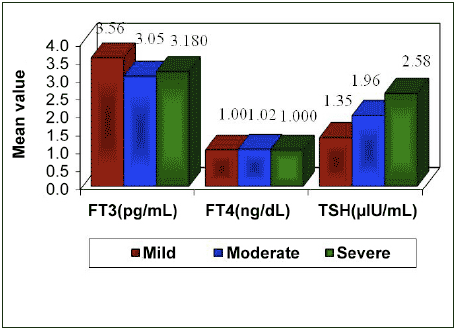
Thyroid Hormone Levels Based on Severity of Dental Fluorosis (Hosur 2012).
Studies investigating fluoride’s impact on thyroid hormone levels have produced divergent findings, but are consistent with fluoride having an anti-thyroid effect under certain circumstances. (NRC 2006). The most common thyroid effect associated with fluoride exposure appears to be an increase in TSH levels, with or without a corresponding effect on T3 or T4. (Susheela 2005). One of the most recent studies, for example, found a trend towards higher TSH in children based on the severity of their dental fluorosis, but without a significant effect on either T3 or T4. (Hosur 2012, see figure). These and other findings indicate that fluoride can contribute to a subclinical, if not clinical, hypothyroid condition. It remains difficult to predict the toxic dose, however, as it appears to depend, in part, on the nutritional and health status of the individual, particularly the adequacy of iodine intake. (NRC 2006).
Fluoride Exacerbates the Impact of Iodine Deficiency
A consistent body of animal and human research shows that fluoride exposure worsens the impact of an iodine deficiency. (Gas’kov 2005; Hong 2001; Wang 2001; Zhao 1998; Xu 1994; Lin 1991; Ren 1989; Guan 1988). Iodine is the basic building block of the T3 and T4 hormones and thus an adequate iodine intake is essential for the proper functioning of the thyroid gland. When iodine intake is inadequate during infancy and early childhood, the child’s brain can suffer permanent damage, including mental retardation. (Iodine deficiency is the leading cause of mental retardation throughout the world.)
In China, researchers have repeatedly found that an iodine deficiency coupled with fluoride exposure produces a significantly more damaging effect on neurological development than iodine deficiency alone. (Hong 2001; Xu 1994; Lin 1991; Ren 1989). The studies, which utilize childhood intelligence as the metric for assessing neurological health, have found that fluoride levels as low as 0.9 ppm can worsen the IQ effect of iodine deficiency. (Lin 1991). This concentration is within the purported “optimal” range of fluoride that is added to water in water fluoridation programs (0.7-1.2 ppm). While many studies have found an association between fluoride and reduced IQ among children with adequate iodine intake, (Choi 2012), an iodine deficiency will lower the threshold at which fluoride damages the brain. (Xu 1994; Guan 1988). An iodine deficiency will also lower the threshold for other forms of fluoride toxicity as well, including dental fluorosis. (Zhao 1998; see also Pontigo-Loyola 2008).
Iodine Deficiency Remains a Public Health Concern in the U.S.
Despite the widespread availability of iodized salt, iodine deficiency has re-emerged as a public health concern in the United States. (CDC 1998). More than 11% of all Americans, and more than 15% of American women of child-bearing age, presently have urine iodine levels less than 50 mcg/L (Caldwell et al., 2008), indicating moderate to severe iodine deficiency. An additional 36% of reproductive-aged women in the U.S. are considered mildly iodine deficient (<100 mcg/L urinary iodine). Fluoride’s ability to worsen the effects of an iodine deficiency could thus be highly relevant to populations in the U.S. The National Research Council has therefore called upon the scientific community to begin investigating the interactive effects of fluoride and iodine in U.S. populations. So far, no such research has been conducted.
Fluoride & Goitre
Studies dating back to the 19th century have implicated fluoride as a possible cause of goitre. Goitre (aka goiter) is an enlargement of the thyroid gland that in some cases can produce visible swelling in the neck. Although the main cause of goitre is iodine deficiency, it can also be caused by other things, including hypothyroidism and goitrogens (substances that cause goitre). Studies that have examined human populations with adequate intake of iodine have reported mixed results about fluoride’s ability to produce goitre. (NRC 2006; Burgi 1984; McLaren 1969). The research has been more consistent, however, where the examined populations had either excessive iodine intakes, or deficient iodine intakes. (Gas’kov 2005; Hong 2001; Wang 2001; Xu 1994; Yang 1994; Lin 1986). Most of this latter research was initially published in either Russian or Chinese and was only recently translated into English by the Fluoride Action Network. Accordingly, previous reviews of fluoride/goitre research (e.g., NRC 2006) were not able to take these studies into account. As such, the evidence linking fluoride to goitre for populations with excessive, or deficient, iodine exposure is stronger than previously recognized. Read more.
Fluoride, Thyroid, & Dogs
An investigation by the Environmental Working Group found that commercial dog food contains very high levels of fluoride (due, in part, to the presence 0f fluoride-rich bone particles). Since dogs have been found to suffer a high incidence of hypothyroidism, the relationship between fluoride contamination and thyroid disease in dogs deserves further attention, particularly since it was fluoride’s production of goiter in dogs that first prompted the idea that fluoride could be an anti-thyroid agent. (Maumene 1854).
References:
- Bachinskii PP et al. 1985. Action of the body fluorine of healthy persons and thyroidopathy patients on the function of hypophyseal-thyroid the system. Probl Endokrinol (Mosk) 31(6):25-9.
- Burgi H, et al. (1984). Fluorine and the Thyroid Gland: A Review of the Literature. Klin Wochenschr. 1984 Jun 15;62(12):564-9.
- Caldwell KL, et al. (2008). Iodine status of the U.S. population, National Health and Nutrition Examination Survey 2003-2004. Thyroid 18(11):1207-14.
- Choi AL, et al. (2012). Developmental Fluoride Neurotoxicity: A Systematic Review and Meta-Analysis. Environmental Health Perspectives 2012 Jul 20. [Epub ahead of print]
- Galletti P, Joyet G. (1958). Effect of fluorine on thyroidal iodine metabolism in hyperthyroidism. Journal of Clinical Endocrinology 18(10):1102-1110.
- Gas’kov A, et al. (2005). The specific features of the development of iodine deficiencies in children living under environmental pollution with fluorine compounds. Gig Sanit. Nov-Dec;(6):53-5.
- Gencer B, et al. (2012). Subclinical thyroid dysfunction and the risk of heart failure events: An individual participant data analysis from six prospective cohorts. Circulation 2012 Jul 19. [Epub ahead of print]
- Guan ZZ, et al. (1988). Synergistic action of iodine-deficiency and fluorine-intoxication on rat thyroid. Chinese Medical Journal 101(9):679-84.
- Hong F, et al. (2001). Research on the effects of fluoride on child intellectual development under different environmental conditions. Chinese Primary Health Care 15: 56-57.
- Hosur MB, et al. (2012). Study of thyroid hormones free triiodothyronine (FT3), free thyroxine (FT4) and thyroid stimulating hormone (TSH) in subjects with dental fluorosis. European Journal of Dentistry 6:184-90.
- Klein RZ, et al. (2010). Relation of severity of maternal hypothyroidism to cognitive development of offspring. Journal of Medical Screening 8(1):18-20.
- Haddow JE, et al. (1999). Maternal thyroid deficiency during pregnancy and subsequent neuropsychological development of the child. New England Journal of Medicine 341(8):549-55.
- Lin F, et al (1991). The relationship of a low-iodine and high-fluoride environment to subclinical cretinism in Xinjiang. Endemic Disease Bulletin 6(2):62-67 (republished in Iodine Deficiency Disorder Newsletter Vol. 7(3):24-25).
- Lin F, et al. (1986). A preliminary approach to the relationship of both endemic goiter and fluorosis in the valley of Manasi River, Xin-Jiang to environmental geochemistry. Chinese Journal of Endemiology 5(1):53-55.
- Maumené E. (1854). Experiencé pour déterminer l’action des fluores sur l’economie animale. Compt Rend Acad Sci (Paris) 39:538-539.
- Mikhailets ND, et al. (1996). Functional state of thyroid under extended exposure to fluorides. Probl Endokrinol (Mosk) 42:6-9.
- National Research Council. (2006). Fluoride in drinking water: a scientific review of EPA’s standards. National Academies Press, Washington D.C.
- Peckham S, et al. (2015). Are fluoride levels in drinking water associated with hypothyroidism prevalence in England? A large observational study of GP practice data and fluoride levels in drinking water. Journal of Community Health & Epidemiology [Epub ahead of print].
- Pontigo-Loyola A, et al. (2008). Dental fluorosis in 12- and 15-year-olds at high altitudes in above-optimal fluoridated communities in Mexico. Journal of Public Health Dentistry 68(3):163-66.
- Ren D, et al. (1989). A study of the intellectual ability of 8-14 year-old children in high fluoride, low iodine areas. Chinese Journal of Control of Endemic Diseases 4:251.
- Rodondi N, et al. (2010). Subclinical hypothyroidism and the risk of coronary heart disease and mortality. JAMA 304(12):1365-74.
- Susheela AK, et al. (2005). Excess fluoride ingestion and thyroid hormone derangements in children living in New Delhi, India. Fluoride 38:98-108.
- Wang X, et al. (2001). Effects of high iodine and high fluorine on children’s intelligence and thyroid function. Chinese Journal of Endemiology 20(4):288-90.
- Xu Y, et al. (1994). The effect of fluorine on the level of intelligence in children. Endemic Diseases Bulletin 9(2):83-84.
- Yang Y, et al. (1994). The effects of high levels of fluoride and iodine on intellectual ability and the metabolism of fluoride and iodine. Chinese Journal of Epidemiology 15(4):296-98 (republished in Fluoride 2008; 41:336-339).
- Yao Y, et al. (1996). Analysis on TSH and intelligence level of children with dental Fluorosis in a high fluoride area. Literature and Information on Preventive Medicine 2(1):26-27.
- Yu Y. (1985). Study on serum T4, T3, and TSH levels in patients with chronic skeletal fluorosis. Chinese Journal of Endemiology 4(3):242-43.
- Zhao W, Zhu H, Yu Z, Aoki K, Misumi J, Zhang X. 1998. Long-term effects of various iodine and fluorine doses on the thyroid and fluorosis in mice. Endocrine Regulation 32(2):63-70.
 Print
Print  PDF
PDF
-
-
Health Warning: The Thyroid and Fluoride
There are four important lines of evidence that indicate fluoride interferes with the thyroid gland. This article briefly summarizes each of these four areas.
-
Decrease of Iodine Intake Found in Americans
The iodine status of Americans has changed significantly over the past 20 years, according to a Centers for Disease Control and Prevention (CDC) study published in October's Journal of Clinical Endocrinology and Metabolism. While there were concerns in the 1970's and 1980's about possible high iodine intake, a laboratory indicator
Related Articles:
-
-
-
The Relationship Between Fluoride Exposure & Goitre in South Africa
As a general rule simple goitre, irrespective of the cause, can be very, or fairly, satisfactorily combated by an adequate increase in man's daily iodine intake, except when the enlargement of the gland is due to the ingestion of excessive amounts of fluorine. The only correct solution to fluorine-induced endemic goitre is the removal of this element from the drinking water.
-
Fluorine in the Aetiology of Endemic Goitre
The distribution of endemic goitre in the Punjab and in England is related to the geological distribution of fluorine and to the distribution of human dental fluorosis (mottled enamel). Inquiry showed the presence of dental fluorosis among school-children in two areas of Somerset where two previous observers had recorded a high incidence of goitre, and the absence of dental fluorosis in an adjoining area selected as control where endemic goitre was absent.
-
Fluoride, Water Hardness, and Endemic Goitre
Variations in goitre prevalence were found to correlate closely with the fluoride content (p=0-74; P<0-01) and with the hardness (p=0.77; P<0-01) of the water in each village. The effects of fluoride and water hardness seem to be independent.
Related Studies:
-
-
-
Email Exchange with FDA re: Fluoride Supplements
Email exchange regarding FDA's reasons for not approving fluoride supplements.
-
Harvard's Statement on Chester Douglass/Scientific Misconduct
Statement Concerning the Outcome of the Review into Allegations of Research Misconduct Involving Fluoride Research BOSTON-August 15, 2006-The Harvard Medical School and School of Dental Medicine (HSDM) review of Chester Douglass, DMD, PhD, professor of oral health policy and epidemiology at HSDM, has concluded that Douglass did not intentionally omit, misrepresent,
-
The 'Altered Recommendations' of the 1983 Surgeon General's Panel
"We believe that EPA staff and managers should be called to testify, along with members of the 1983 Surgeon Generals panel and officials of the Department of Human Services, to explain how the original recommendations of the Surgeon Generals panel were altered to allow EPA to set otherwise unjustifiable drinking water standards for fluoride."
Related Miscellaneous Content:
-